Opening Hook
The first Moon landing was watched as a triumph. The conspiracy version begins with a darker premise: NASA had the money, cameras, Cold War pressure, and motive to stage the whole thing.
That story gained cultural fuel in the 1970s, especially after Bill Kaysing’s self-published book We Never Went to the Moon: America’s Thirty Billion Dollar Swindle helped popularize the modern moon-hoax narrative, as summarized by the Smithsonian Magazine and the University of Manchester.
The Claim
The claim is not merely that a photograph looks strange or that NASA managed the Apollo program carefully for public consumption. The stronger claim is that NASA faked the Apollo moon landings and that astronauts did not walk on the Moon.
The article classification is therefore conspiracy theory. The evidence verdict is different: the claim is debunked.
Where It Came From
NASA’s Apollo 11 mission landed Neil Armstrong and Buzz Aldrin on the Moon on July 20, 1969, while Michael Collins remained in lunar orbit, according to NASA’s Apollo 11 mission page. Five more Apollo missions later landed astronauts on the lunar surface.
The hoax story grew after the landings, not before them. Kaysing’s 1970s claims landed in a culture already primed by Vietnam, Watergate, intelligence scandals, and a broader collapse of trust in official institutions. That context matters: the conspiracy spread because it offered a simple, cinematic answer to a complicated national achievement.
Why It Sounds Plausible
The theory survives because the surface-level questions are sticky. Why are there no stars in many photos? Why does the flag look like it is waving? Why do shadows point in different directions? Why did NASA stop going after Apollo 17?
Those questions are good hooks. They are not, by themselves, good evidence. The strongest version of the hoax argument depends on treating visual oddities as more important than physical samples, independent tracking, mission records, and hardware left on the lunar surface.
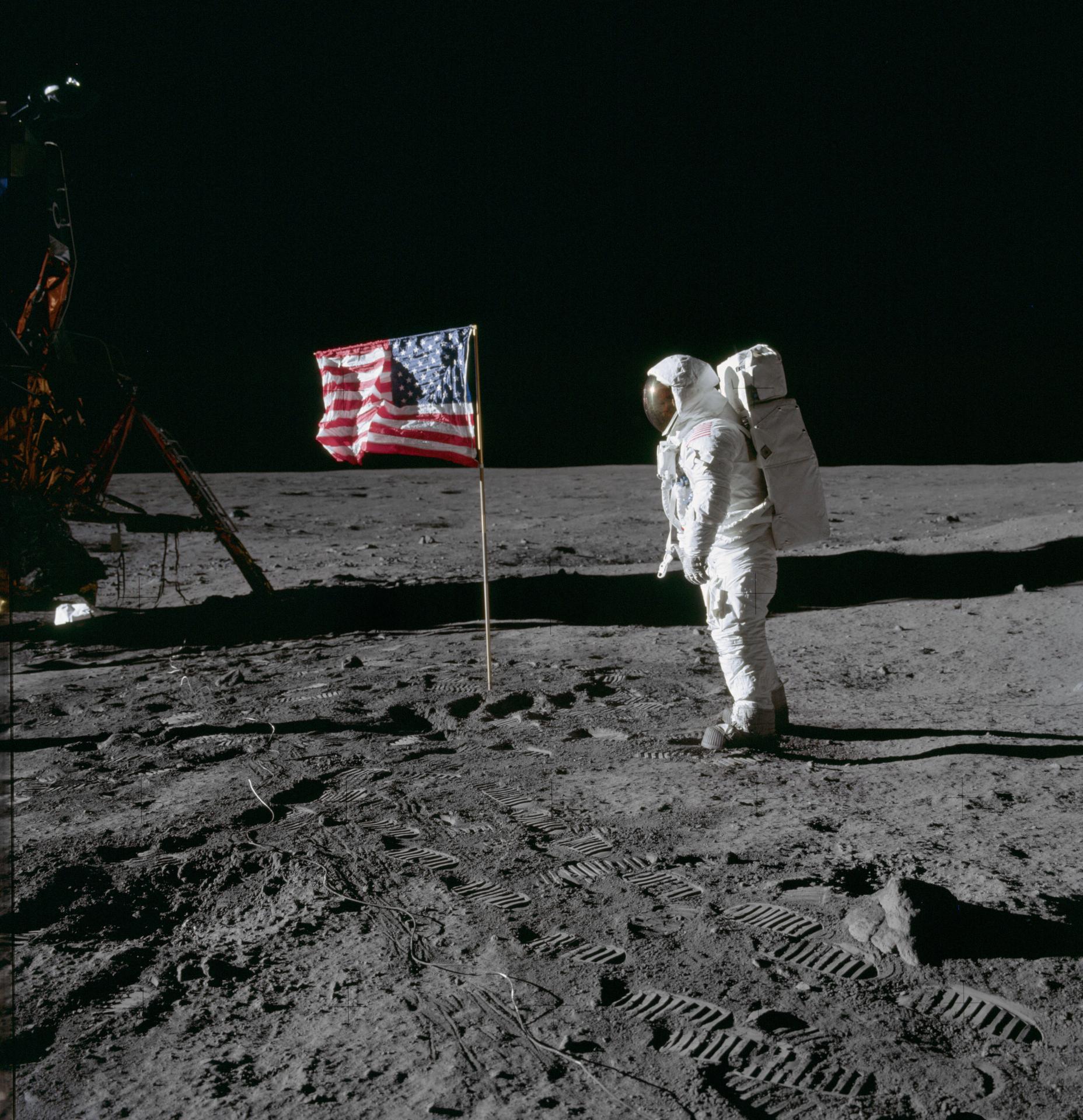
NASA image AS11-40-5875: Buzz Aldrin beside the U.S. flag during Apollo 11. The flag’s shape is one of the most repeated hoax claims, but the image itself is part of the public Apollo photographic record. Image credit: NASA.
Evidence Board
| Claim | What believers say | What evidence shows | Verdict |
|---|---|---|---|
| The flag appears to wave. | There must have been wind in a studio. | The flag had a horizontal support rod and could retain a rippled shape after being handled; Royal Museums Greenwich addresses the flag claim as a common misunderstanding of lunar conditions. | Debunked |
| No stars appear in many photos. | A real lunar sky should be filled with stars. | Lunar daylight, bright suits, reflective surface, and camera exposure settings make stars too dim to show in many surface photos. | Debunked |
| Shadows look inconsistent. | Multiple studio lights must have been used. | Uneven terrain, perspective, and wide-angle photography can make shadows appear non-parallel in a two-dimensional image. | Debunked |
| The Van Allen belts would have killed the crew. | Radiation exposure made the trip impossible. | Apollo trajectories minimized exposure time, spacecraft shielding reduced dose, and mission dosimetry did not show fatal exposure. | Debunked |
| There should be no remaining proof on the Moon. | NASA only has old photos and testimony. | The Lunar Reconnaissance Orbiter has imaged Apollo landing sites, and NASA Science hosts Apollo 11 landing-site imagery from LRO. | Debunked |
| Moon rocks could have been faked. | NASA could have staged samples or used Earth rocks. | Apollo missions returned 842 pounds, or 382 kilograms, of lunar rock and soil, according to NASA Science’s Moon facts and Apollo sample materials. | Debunked |
| A studio production would have been easier. | NASA had motive and cameras. | The cover-up would have required silence and technical coordination across NASA, contractors, researchers, tracking stations, and rival observers for decades. | Unsupported |
The Smoking Gun Test
The strongest evidence is not one photograph. It is convergence.
NASA’s lunar samples are still studied; NASA Science states that Apollo astronauts returned 382 kilograms of lunar material. NASA’s Lunar Reconnaissance Orbiter has imaged the Apollo 11 landing site. Apollo-era laser retroreflectors still support lunar laser ranging work, with NASA Goddard describing Apollo 11 reflectors as continuing to provide fresh lunar laser ranging data.
Any single piece can be argued over. All of them together make the hoax claim collapse.
The Twist
The interesting story is not that Apollo was fake. It is that the hoax theory became emotionally durable.
The theory gives people a villain, a secret stage, an impossible-looking achievement, and a post-Watergate mood of distrust. In that sense, the claim is a cultural artifact as much as an evidence dispute. It reveals how a public can treat visual uncertainty as stronger than physical evidence when institutional trust is low.
Logical Fallacies And Reasoning Patterns
Argument from incredulity
Apollo was hard. That does not mean Apollo was impossible. “I cannot imagine how they did it” is not evidence that they did not.
Cherry-picking
Hoax arguments often linger on photographic details while stepping around the larger source record: mission telemetry, returned samples, landing-site imaging, experiments, and independent scientific work.
Moving goalposts
When one photo claim is explained, the argument often shifts to another photo, then to radiation, then to moon rocks, then to the size of the conspiracy. The test keeps changing because the conclusion is fixed first.
Impossible conspiracy scale
A staged Apollo program would not only require a film set. It would require decades of silence from engineers, astronauts, contractors, scientists, trackers, researchers, and geopolitical rivals who had incentive to expose a fraud.
What Would Change The Verdict?
A serious challenge would need authenticated evidence that beats the existing record: original production records for staged Apollo footage, reliable physical evidence contradicting lunar sample provenance, or independent archival proof that tracking and mission data were fabricated.
Photographic oddities and “it looks wrong” arguments are not enough.
Final Verdict
Classification: Conspiracy theory
Verdict: Debunked
Confidence: High
The Apollo moon landings are supported by converging evidence: mission records, returned lunar samples, hardware and experiments left on the Moon, landing-site imagery, and decades of independent scientific use of Apollo material and instruments. The hoax theory remains culturally fascinating, but it does not survive the evidence board.
Shareable Takeaways
- The claim is a conspiracy theory; the evidence verdict is debunked.
- The best evidence is cumulative: samples, images, tracking, retroreflectors, and mission records.
- The real twist is trust. The theory spread because the 1970s were fertile ground for suspicion.
Sources
- NASA. “Apollo 11”. NASA, accessed 2026-06-07.
- NASA Science. “Buzz Aldrin Stands Beside the U.S. Flag on the Moon”. NASA, accessed 2026-06-07.
- NASA Science. “Moon Facts”. NASA, accessed 2026-06-07.
- NASA Science. “Apollo 11 Landing Site”. NASA, accessed 2026-06-07.
- NASA Goddard Space Flight Center. “Reflectors placed on the moon by Apollo 11 astronauts 50 years ago continue to provide fresh lunar laser ranging data”. NASA, accessed 2026-06-07.
- Royal Museums Greenwich. “Moon landing conspiracy theories, debunked”. Royal Museums Greenwich, accessed 2026-06-07.
- Smithsonian Magazine. “How ‘Fly Me to the Moon’ Pokes Fun at Moon Landing Conspiracy Theories”. Smithsonian Magazine, accessed 2026-06-07.
- University of Manchester. “How moon landing conspiracy theories began and why they persist today”. University of Manchester, accessed 2026-06-07.