Opening Hook
The document at the center of the claim is not hidden. The United Nations describes Agenda 21 as a “comprehensive plan of action” for sustainable development, adopted by more than 178 governments at the 1992 Earth Summit in Rio de Janeiro.
The conspiracy version tells a darker story: that a public UN action plan is really a covert blueprint for one-world government, property confiscation, and local planning mandates imposed through city councils, zoning boards, and sustainability programs.
That story gained enough traction to reach state legislatures and the 2012 Republican Party platform. But the evidence does not support the takeover claim.
The Claim
The claim is not merely that Agenda 21 promotes sustainability or encourages local planning. It does. The stronger claim is that Agenda 21 is a covert mechanism for the United Nations to establish a one-world government, eliminate private property rights, and impose local planning mandates under the cover of environmental policy.
The article classification is therefore conspiracy theory. The evidence verdict is different: the claim is debunked.
Where It Came From
Agenda 21 came out of the United Nations Conference on Environment and Development, held in Rio de Janeiro from June 3 to 14, 1992. The UN’s summary says Agenda 21, the Rio Declaration, and forest-principles statement were adopted by more than 178 governments.
The document itself is a 351-page action plan organized around four sections: social and economic dimensions, conservation and management of resources, strengthening the role of major groups, and means of implementation. It uses broad, bureaucratic language about poverty, consumption, land use, pollution, public participation, and development.
Local planning became the flashpoint because of Chapter 28, “Local Authorities’ Initiatives in Support of Agenda 21.” That chapter says each local authority should enter a dialogue with citizens, local organizations, and private enterprises and adopt “a local Agenda 21” through consultation and consensus-building in its own community.
Anti-Agenda 21 activists treated that local language as evidence of a UN pipeline into zoning and property decisions. By 2012, the claim had moved into mainstream conservative politics. The 2012 Republican Party platform said the party “strongly reject[s] the U.N. Agenda 21 as erosive of American sovereignty.”
Statehouse fights followed. Alabama’s SB477 passed in 2012 and was assigned Act No. 2012-598, with LegiScan summarizing the bill as a prohibition on state and local environmental-development policies that would infringe due process rights. Other anti-Agenda 21 bills were introduced or advanced in places including Arizona, Missouri, Oklahoma, and Texas, though many failed, died in committee, or were vetoed.
Why It Sounds Plausible
The theory survives because Agenda 21 is big, vague in places, and connected to real local policy debates. Land use, transportation planning, conservation, housing density, infrastructure, and environmental rules can all affect property owners. People can reasonably disagree about those policies without believing in a secret UN takeover.
The strongest version of the conspiracy argument points to phrases like “changing consumption patterns,” “integrating environment and development in decision-making,” and Chapter 28’s call for local authorities to assess and modify policies. Read in isolation, those phrases can sound more sweeping than they are.
But plausibility is not proof. The leap from “local governments may consult citizens about sustainability planning” to “the UN can seize property and impose world government” is where the claim breaks.
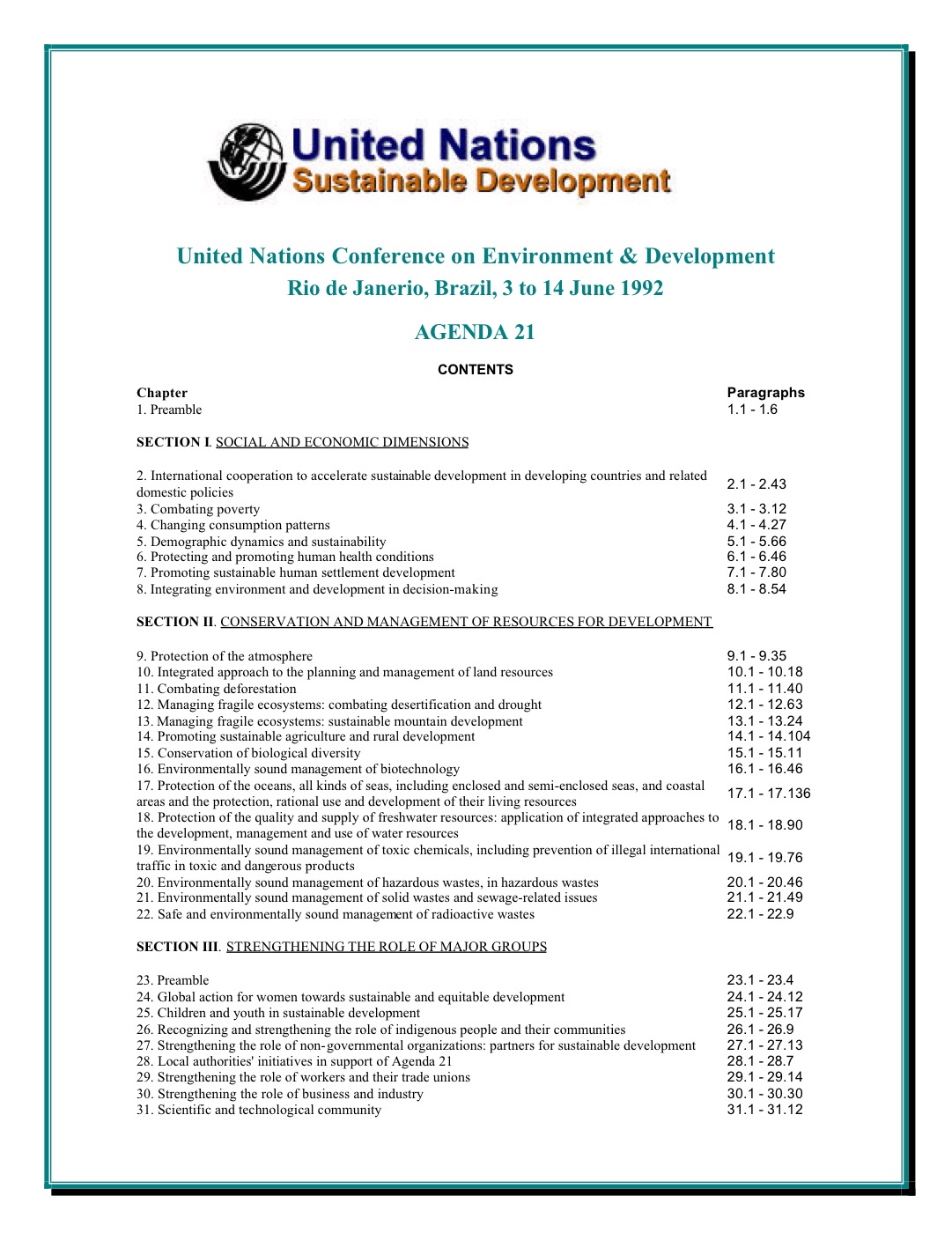
The public Agenda 21 document hosted by the United Nations. The table of contents shows the plan’s broad sustainable-development scope, including its section on local authorities. Image derived from the UN-hosted Agenda 21 PDF.
Evidence Board
| Claim | What believers say | What evidence shows | Verdict |
|---|---|---|---|
| Agenda 21 is a binding treaty. | The UN will enforce it through international law. | Agenda 21 is an action plan, not a treaty. ICLEI USA states it is “not a treaty or legally binding document,” and the UN source describes follow-up and monitoring, not enforcement. | Debunked |
| Agenda 21 eliminates private property rights. | The UN will seize property for sustainable development. | The document contains no property-seizure authority. Property rights and land-use decisions remain under national, state, and local law. | Debunked |
| Agenda 21 creates one-world government. | Sustainability language is a cover for global political control. | The document calls for cooperation among governments, UN bodies, and major groups; it does not create supranational government or give the UN domestic governing power. | Debunked |
| Local planning mandates are imposed from above. | Cities are forced to adopt Agenda 21 policies. | Chapter 28 calls for local dialogue and consultation. ICLEI USA says its programs are voluntary and that local governments define their own goals. | Debunked |
| The plan is secret. | The UN is hiding the real purpose. | Agenda 21 is publicly hosted in full by the UN, and the local-authority language is in the public PDF. | Debunked |
| Sustainability equals Agenda 21 control. | Any sustainability project is evidence of the plot. | Sustainability is a mainstream planning concept. A local bike lane, zoning update, or conservation program is not evidence of UN legal authority. | Unsupported |
The Smoking Gun Test
The alleged smoking gun is Chapter 28. It is the section critics point to when they argue that Agenda 21 enters American life through town halls and planning departments.
But Chapter 28 does not give the UN command authority over cities. It says local authorities should enter dialogue with citizens, local organizations, and private enterprises, then adopt local plans through consultation and consensus-building. That is political language, not an enforcement mechanism.
The best evidence against the conspiracy is the structure of the document itself: Agenda 21 is public, programmatic, and dependent on governments and local actors choosing what to do. ICLEI USA, a frequent target of the conspiracy, says its programs are voluntary, that it is not controlled by the UN, and that it has no authority over local government members.
The Twist
The interesting story is not that Agenda 21 secretly took over local government. It is that the conspiracy theory became politically useful.
The American Planning Association’s 2012 survey found that 85% of Americans did not know enough about Agenda 21 to hold an opinion, while 6% opposed it and 9% supported it. That information gap made the phrase easy to fill with fear.
For activists suspicious of the UN, Agenda 21 turned abstract anxieties about sovereignty, federalism, environmental regulation, and property rights into a single target. For local officials, it turned routine planning fights into evidence of a global plot. Alabama’s 2012 law shows the pattern: a non-binding UN document produced a binding state-level response against a feared future infringement.
The conspiracy theory’s success says more about American distrust of institutions than it says about the legal power of the UN.
Logical Fallacies And Reasoning Patterns
Argument from incredulity
Agenda 21 is broad and bureaucratic. That does not mean it hides a totalitarian design. “This sounds too sweeping to be harmless” is a suspicion, not evidence.
Cherry-picking
Conspiracy arguments often quote planning language while stepping around the larger context: public adoption, voluntary implementation, local consultation, and the absence of enforcement language.
Moving goalposts
When Agenda 21 is shown to be non-binding, the argument often shifts to claiming that non-binding language is itself part of the deception.
Impossible conspiracy scale
A secret Agenda 21 takeover would require decades of coordinated silence from national governments, local officials, planners, NGOs, community groups, and citizens across many countries.
False dilemma
The claim presents only two choices: either all sustainability planning is innocent, or it is a covert takeover. Reality is messier. Some planning policies can be good, bad, overbroad, or locally controversial without being proof of UN control.
What Would Change The Verdict?
A serious challenge would need authenticated evidence that contradicts the public document and current institutional record: secret binding protocols, enforceable UN directives to local governments, court-recognized property seizures traceable to Agenda 21 authority, or internal records showing coordinated deception.
Broad language in a public document, plus local political fights over planning, is not enough.
Final Verdict
Classification: Conspiracy theory
Verdict: Debunked
Confidence: High
Agenda 21 is a public, non-binding sustainable-development action plan. It contains no UN enforcement mechanism, no property-seizure authority, and no one-world-government provision. The conspiracy theory became politically effective, but it does not survive the evidence board.
Shareable Takeaways
- The claim is a conspiracy theory; the evidence verdict is debunked.
- Agenda 21 was adopted by more than 178 governments in 1992, but it is not a treaty and does not give the UN local governing power.
- The local-planning section calls for consultation with citizens and local organizations, not UN control over zoning boards.
- The real twist is political: a public sustainability action plan became a proxy fight over sovereignty, property rights, and distrust of institutions.
Sources
- United Nations Department of Economic and Social Affairs. “Agenda 21 - Comprehensive Plan”. United Nations, accessed 2026-06-08.
- United Nations. “Agenda 21 PDF”. United Nations, accessed 2026-06-08.
- ICLEI USA. “Addressing Agenda 21 and United Nations ‘One World’ Conspiracies”. ICLEI USA, accessed 2026-06-08.
- The American Presidency Project. “2012 Republican Party Platform”. University of California, Santa Barbara, accessed 2026-06-08.
- LegiScan. “AL SB477 | 2012 | Regular Session”. LegiScan, accessed 2026-06-08.
- American Planning Association. “Planning in America: Perceptions and Priorities 2012”. American Planning Association, accessed 2026-06-08.
- The Guardian. “Agenda 21: a conspiracy theory puts sustainability in the crosshairs”. The Guardian, accessed 2026-06-08.
- Southern Poverty Law Center. “Republican National Committee Calls Agenda 21 a Plan for Global Control”. Southern Poverty Law Center, accessed 2026-06-08.